Remarks on Scale and Terrain Design
by Dean West
A Miniatures war game table based on a ground scale vast enough to accommodate large battles of the Horse and Musket period on an average sized tabletop ought to convey the feel of wide open spaces. The visual impression should evoke a sense of spacious, uncluttered and rolling countryside that bears a strong resemblance to real farm and wood lands when observed from an airplane soaring 3000 scale feet above it. If we are interested in creating this harmonious, aesthetically pleasing panoramic effect, the buildings and other scenery and effects we use to create out tabletop scenery must be as compatible with the ground scale as possible.
 |
Dean West running one of his 15mm "Final Argument of Kings" games.
Thanks to Jeff Knudsen at www.warartisan.com for the SYW Convention pictures. |
Ground Scale vs Figure Scale
To explain, the ground scale of the grand-tactical American Civil War game Johnny Reb III (JRIII) is 1 inch equals 50 yards. A 6'x9' JRIII war game table represents an area of terrain measuring approximately three miles by two miles - enough ground on which to fight most historical ACW battles. To envision the scope of this large scale, consider that a modern football field would occupy an area measuring only 1-inch by 2-inches on the game table. The footprint of a scale model ACW period farmhouse should measure about 1/4-inch square by 3/32-inch high. Yet, I doubt any of us would consider using Monopoly houses with 15mm figures. On the other hand, that same farmhouse modeled in the exact scale as the 15mm figures we use occupies a space measuring at least 3 1/2 inch square on the tabletop - 175 yards according to the ground scale! That can't be too much smaller than the area occupied by Chicago's Museum of Science and Industry. Even more detrimental to the overall visual impression than the 15mm farmhouse's large footprint is that it approaches the height of a twelve story building. This means it is even taller than the museum according to ground scale.
The resulting visual effect of the 15mm farmhouse is as incongruous to grand-tactical scale scenery as is using those tiny monopoly buildings with 15mm figures. Consider that if we were to use one 15mm figure to represent one historical soldier in 15mm scale, in the same way that we use one 15mm model building to represent a single farm house, then a battalion of just 200 figures formed in 2-rank line of battle would have a frontage of more than four feet on the tabletop! To say it another way, if we based ground scale on the actual size of 15mm figures, the scale would be 1 inch equals 2 yards. A 6'x9' tabletop, therefore, represents a patch of ground measuring just 144 yards x 216 yards. This would be a pretty good ground scale for a western gunfight skirmish game.
 |
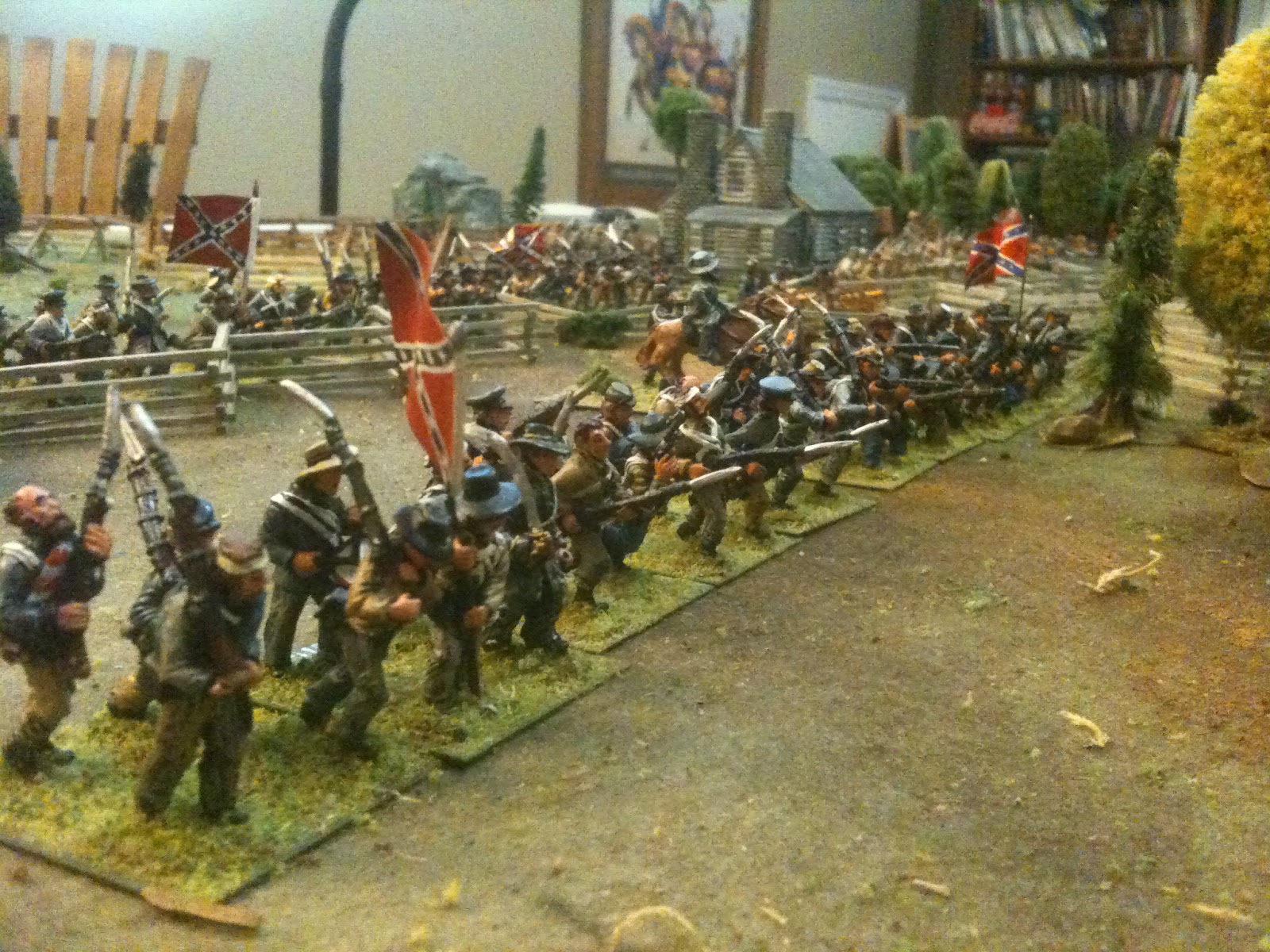
| An old picture of the terrain from Dean's "Piedmont" scenario. |
Issues and Solutions
It does not require a genius to conclude that the sensible way to solve this problem of incompatible ground to figure scale is to use either 5mm or 6mm (I hate the giant heads) or 10mm figures to fight grand-tactical battles. Obviously, the smaller the figure scale, the easier it is to reconcile both figures and buildings to grand tactical ground scale.
My problem with using a smaller figure scale is that designing scenarios representing historical battles and painting 15mm figures are my two favorite aspects of the hobby. 15mm is absolutely the smallest scale that satisfies my desire to paint detailed figures and I have no intention of giving up either. So over the years I've been compelled to develop a number of scenery techniques to mitigate the scale disparity as much as possible while satisfying both of my favorite war gaming interests. Some of my ideas follow:
15mm Figures
I'm pleased to report that 15mm figures are just small enough to look pretty good on an average size grand-tactical tabletop. To form my battalions, I mount them shoulder to shoulder, in two ranks, and I think they look great. The frontage of each unit is from three inches, to somewhat over four inches, depending on whether a unit contains 12, 16 or 20 figures. Based on the JRIII ground scale, this is the proper frontage of historical battalions of similar strength (JRIII figure scale is one figure equals 30 actual soldiers).
 |
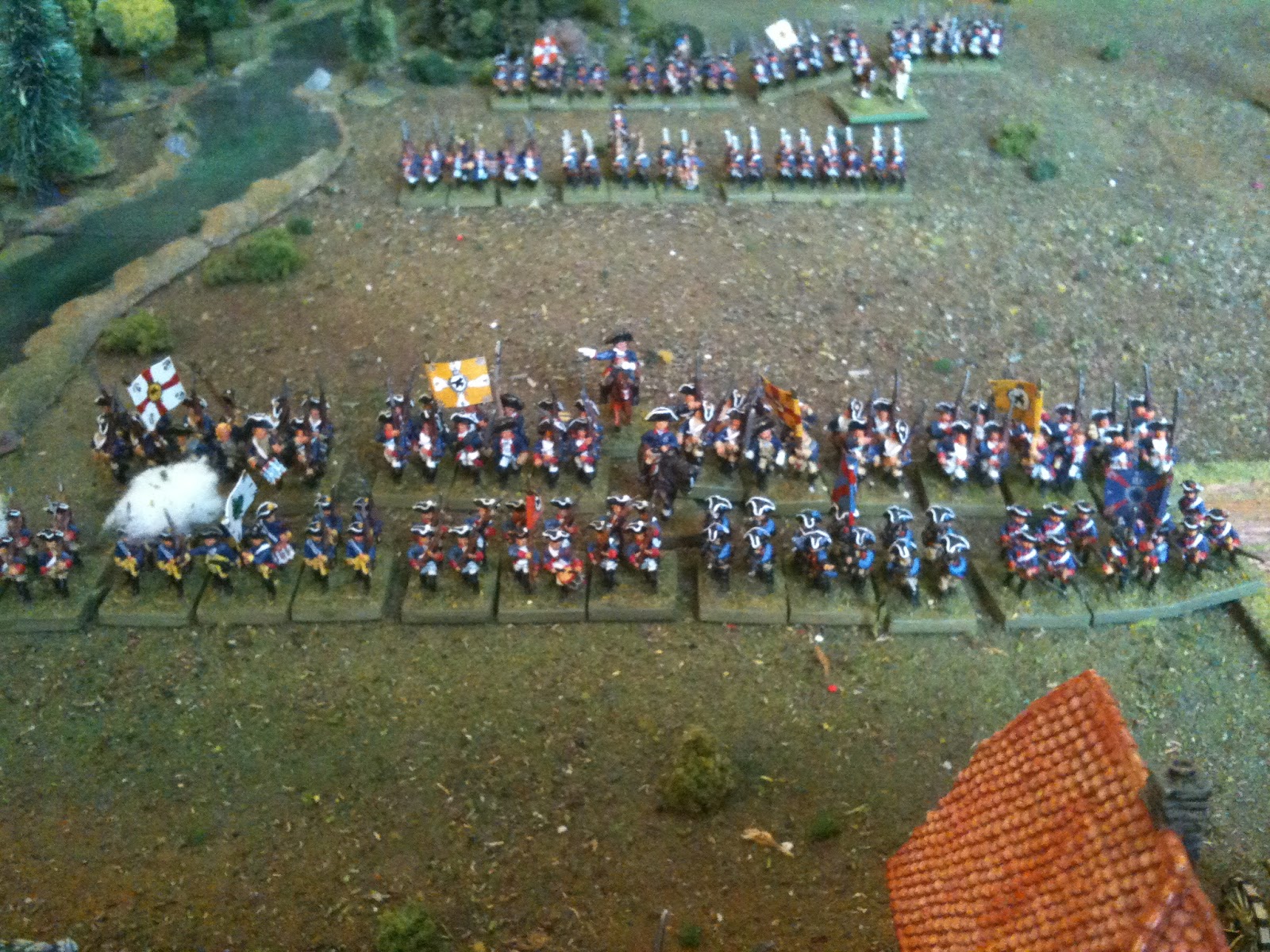
One of Dean's SYW
games at the SYW convention. |
Buildings
Sadly, unlike the figures, 15mm buildings, fences, and even most trees cannot be reconciled to the grand-tactical ground scale. The height of one of these buildings is even more offending to the eye than is the footprint of its base. One can justify the footprint by imagining that just one 15mm building represents the ground occupied by all the buildings and other farm stuff located within proximity to the farmer's house. Truly, it is the soaring height of the 15mm building that is the true enemy of proportionality and the same applies to 15mm fences or stone walls that are around one inch high, and trees that are five or six inches tall. I hasten to clarify that there is absolutely nothing wrong with any of these 15mm scenery items, but I argue that they will look and feel more at home on a tactical or skirmish war game table that uses a smaller ground scale, say 1 inch equals 10 yards.
To reconcile these grand-tactical scale issues, close to twenty years ago I began to use 10mm buildings and fences with my 15mm figures (some N Gauge model railroad buildings also work). 10mm ACW buildings have a very small footprint, usually about one third that of a 15mm model of the same building, if not less. Even better, most are about half the height of an average 15mm building. Sure, this is till out of scale compared to the ground scale; however, like the 15mm buildings, 10mm buildings are just small enough not to appear conspicuously out of scale. The eye of the observer seems to adjust so as to view the tabletop scene as a whole, with the surface of the ground and/or woods taking center stage, visually. A few strategically placed 10mm farmsteads placed here and there actually enhances that sense of vast distance we're trying to convey. Moreover, a couple of small buildings gives a farmstead a more interesting and realistic appearance than is the case if representing it using one towering, incongruous edifice.
 |
| A 15mm building vs a grouping of 10mm buildings. |
I have one tip to consider when painting buildings. Buildings probably should appear lighter than you think they should be. Buildings should never appear dark, not be painted in bright, solid colors. Sunlight washes out all building colors, whether they are made of stone, brick or wood. So when you think you've completed a paint job on a building, mix in a little more white (or sometimes yellow) to the color you used on the building and dry brush the building again a few times.
 |
| A 15mm wagon next to some of Dean's 10mm buildings and fences. |
Fences and Trees
I used to build my own 10mm fences and stone walls to use with my 15mm figures. Building a sufficient number of these was a painfully tedious process, but then I was saved when GHQ came out with its 10mm figure line. In addition to producing exceptionally fine ACW figures that are so well sculpted that I was tempted to change scales, GHQ also offered two types of fencing, plus stone walls. These fences and stone walls are only a bit over 1/4 inch high, yet they blend in perfectly with 15mm figures. When these came on the market, it was if I had been released from bondage!
As for trees, just search for small ones made by Woodland Scenics, or forget about trees altogether and use gobs of Woodland Scenics foliage (we call it "munge") for forest, or a combination of both. I strongly recommend mounting your trees on flocked 1 1/4 fender washers to give them a low center of gravity, so they don't fall over quite so easily.
 |
Another "airplane view" picture of Dean's
ACW Piedmont scenario. |
Part 2 - of Dean's article will be coming in Jan.